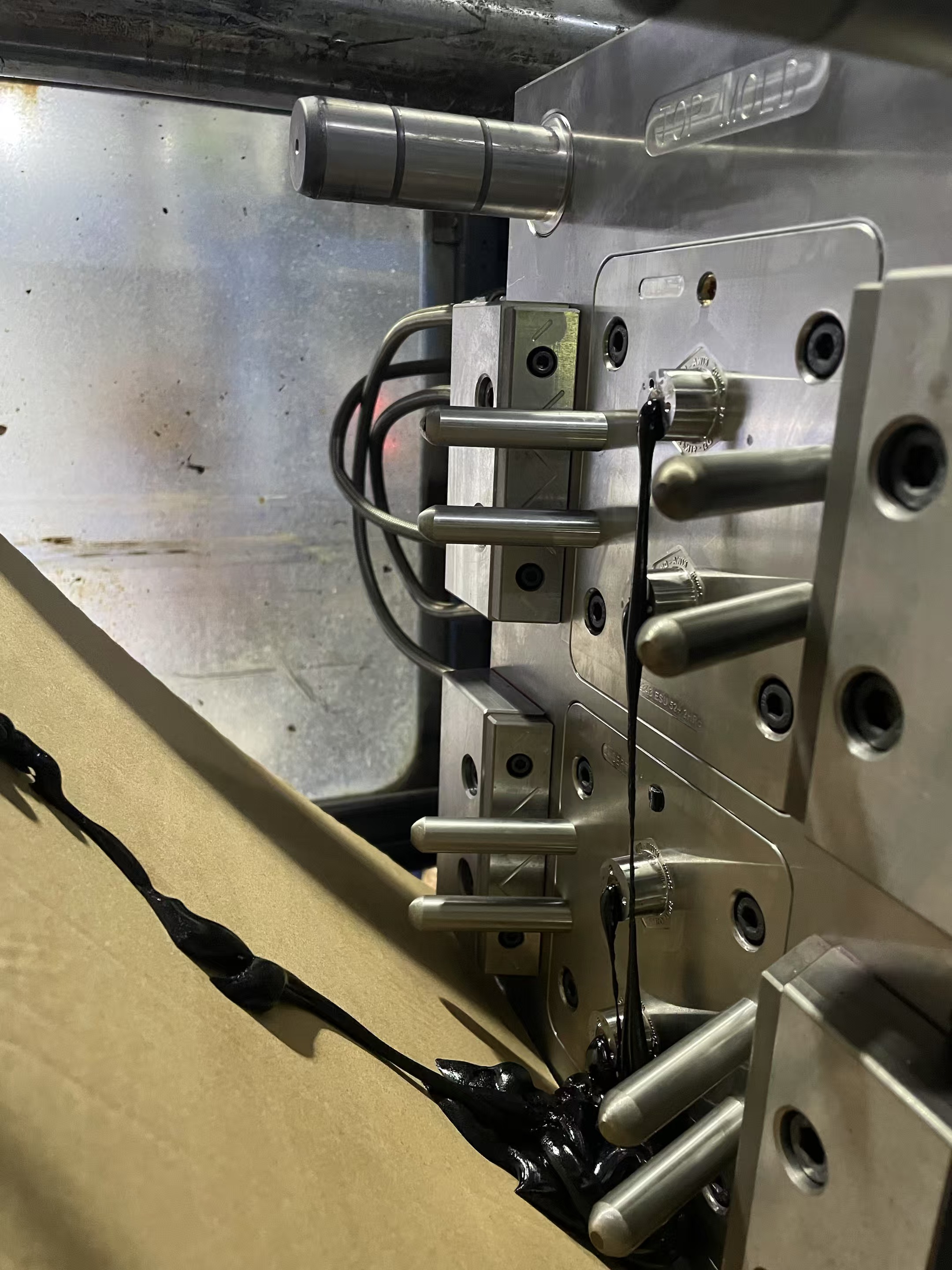
 Case Study: Production Paralysis from Nozzle Blockage
At JBRplas—a Shenzhen-based precision mold maker and injection molder—a critical production halt occurred during the trial phase of an automotive component project. Key details:
- Material: PA66 (Nylon)
- Part: Structural automotive connector
- Mold Configuration: 2-cavity valve-gate hot runner system
- Failure Manifestation: Consistent short shots in one cavity
Diagnostic analysis revealed partial blockage in a hot runner nozzle due to carbonized resin. The root cause? Prolonged material dwell time at operating temperatures (~290°C) caused thermal degradation of PA66, forming carbon deposits that restricted melt flow.
Operational Impact:
- 48-hour production delay
- Material/energy waste from scrapped cycles
- Emergency mold disassembly for nozzle cleaning
- Unplanned costs for troubleshooting and downtime
Hot runners maintain polymer melts at ideal temperatures from machine barrel to cavity, contrasting with cold runners that require reprocessing. Their value proposition includes:
- Cycle Time Reduction (15-30% average): Eliminates cooling/reheating of sprue and runners.
- Material Efficiency: Zero cold runner waste, crucial for expensive engineering resins.
- Quality Consistency: Uniform pressure/temperature distribution minimizes warpage and dimensional variance.
- Aesthetic Precision: Valve gates eliminate gate vestige on finished parts.
- Automation Compatibility: Essential for lights-out manufacturing in high-volume applications.
However, these advantages hinge on meticulous temperature control and maintenance. Nozzle clogging—often from carbon buildup or foreign contaminants—doesn't merely interrupt production; it risks mold damage, inconsistent part quality, and costly secondary operations.
Best Practices for Preventing Nozzle Clogging
Proactive maintenance protocols can mitigate 80% of hot runner failures. JBRplas recommends:
- Thermal Procedure Compliance
- Execute standardized heat-up/cool-down sequences during startups/shutdowns.
- For heat-sensitive resins (e.g., PA66, POM), limit dwell time to <15 minutes at peak temperatures.
- Predictive Maintenance Regimen
- Conduct quarterly nozzle inspections using borescopes to detect carbon buildup.
- Implement ultrasonic cleaning every 50,000 cycles for high-risk materials.
- Material-Component Synergy
- Use beryllium-copper or corrosion-resistant tool steel nozzles for reactive polymers.
- Install melt filters (≤75μm) upstream of hot runners for recycled materials.
- Design-Enabled Reliability
- Balance runner layouts using Moldflow simulation to prevent stagnation zones.
- Incorporate quick-disconnect nozzle assemblies for maintenance accessibility.
Conclusion: Reliability as Competitive Advantage
Hot runner systems represent both a technological asset and a vulnerability vector. As demonstrated by JBRplas' experience, nozzle clogging isn't a minor nuisance—it's a systemic risk compromising cost, quality, and customer trust. Investing in robust hot runner design (e.g., self-cleaning tips, multi-zone thermal control) and disciplined maintenance transforms these systems from failure points into productivity multipliers. Ultimately, in the precision-driven world of injection molding, hot runner reliability isn't optional; it's the foundation of sustainable.
 Case Study: Production Paralysis from Nozzle Blockage