When you pick up an injection molded part with leather texture, matte finish, or a brand logo — how are those textures actually "printed" on?
Many assume they're all applied after molding. In fact, surface decoration falls into two categories: formed during injection molding (integrated into the part itself) and post-molding secondary processing. The logic, cost, and results are completely different.
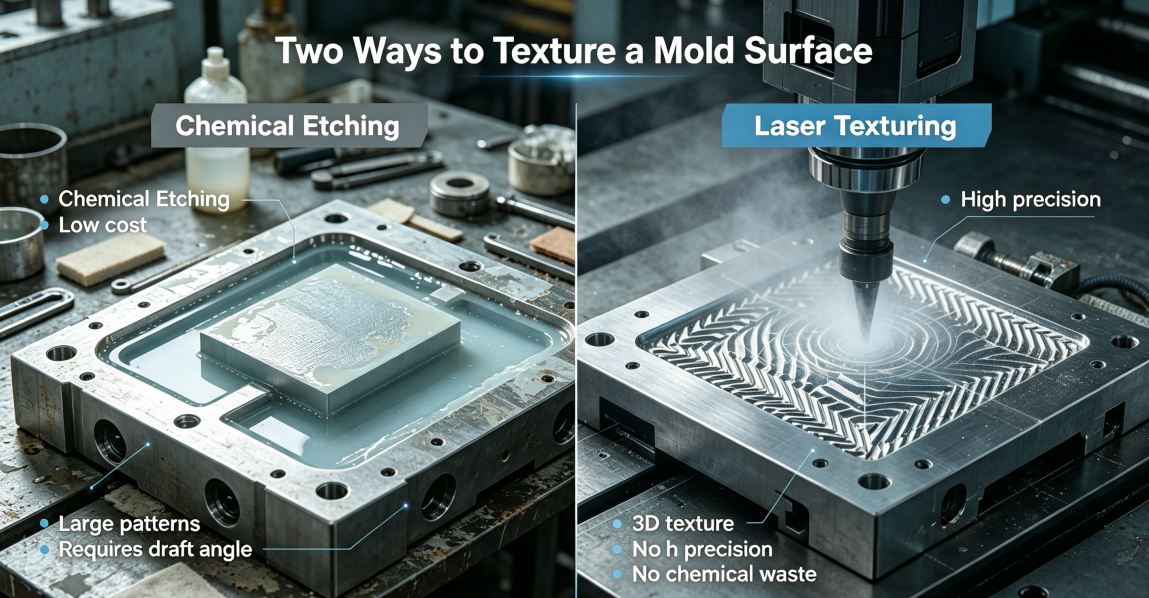
With this approach, the texture is engraved on the mold cavity surface. The plastic part comes out of the mold already textured — no post-processing needed. This is the most efficient and cost-effective method for mass production.
This is the most common method for mold surface texturing. The principle is like "photo developing" — a film mask with the desired pattern is applied to the mold surface, exposed to UV light, and then chemical acids (like sulfuric or nitric acid) etch the unprotected areas to create a textured surface. The plastic then replicates this texture during injection.
What effects can it achieve? Leather grain, wood grain, satin patterns, geometric textures, matte surfaces — almost any texture you can imagine. It also helps hide defects like sink marks, flow lines, and parting lines.
Cost? Relatively low. A typical texturing job costs from a couple hundred to a few thousand dollars, and takes about 3 days.
Caution: Texturing requires draft angles of 5°-8° on the part design; otherwise, the texture may be scratched during ejection.
Traditional chemical etching only works on flat surfaces. Laser texturing can create 3D textures directly on the mold surface using laser ablation — a physical vaporization process that produces no chemical waste and uses less than 3% of the energy of chemical etching.
However, laser equipment is extremely expensive — typically hundreds of thousands of dollars. This method is mainly used for high-end products, small-batch custom parts, or complex 3D textures.
EDM (electrical discharge machining) also leaves a surface texture, but it creates random pits rather than custom patterns. EDM textures are more wear-resistant than chemical etching, making them suitable for high-cycle molds — though the surface finish is less refined.
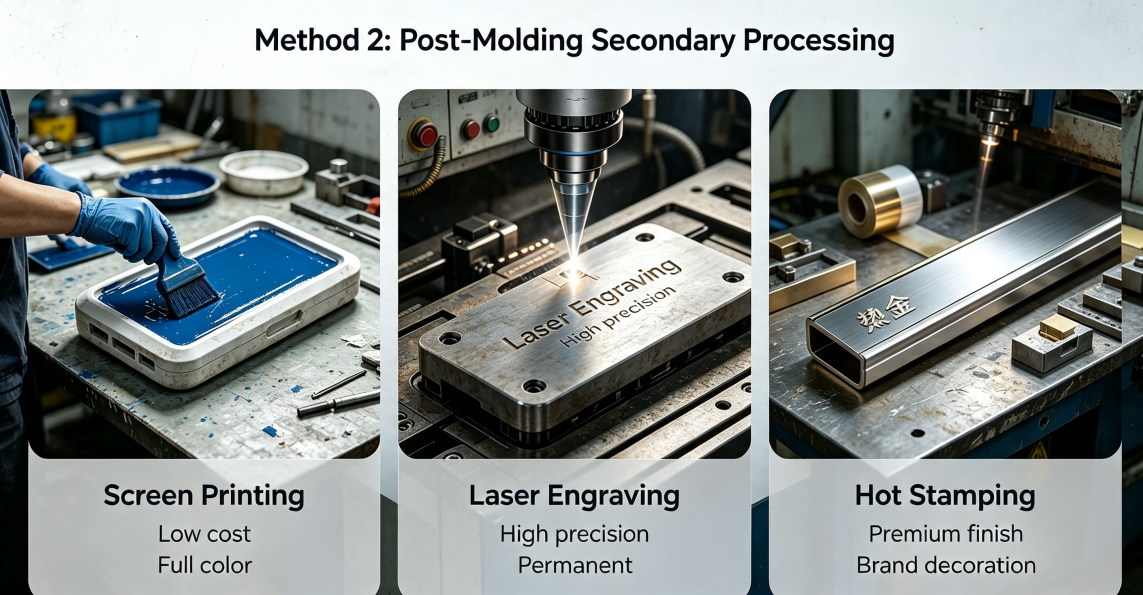
If the part is already molded and needs a logo, text, or design, post-processing is required. These methods either add material to or remove material from the surface without changing the part's basic structure.
Screen printing pushes ink through a mesh stencil onto the surface. Pad printing uses a silicone pad to pick up ink from a steel plate and transfer it onto the part — ideal for curved or irregular surfaces.
Pros: Low cost, simple process, full color options.
Cons: The ink layer sits on the surface and may wear off over time; detail precision is lower than laser engraving, with possible blurring or deformation.
Laser engraving uses a high-energy laser beam to burn away material, creating recessed characters or patterns.
Pros: Extremely high precision, permanent (material is removed, not just coated), works on virtually any surface.
Cons: Only single-color (typically the base material color). No multicolor graphics.
Applies gold or silver foil to the plastic surface using heat and pressure. Requires a stamping die, but tooling costs are low. The effect is refined and luxurious, commonly used for brand logos and decorative trim.
| Factor | Mold-Formed (Etching/Laser) | Post-Processing (Printing/Engraving) |
|---|---|---|
| When applied | During injection | After molding |
| Best for | Large-area texture, grip, anti-slip, matte finish | Logos, text, small decorative elements |
| Durability | High (texture is part of the plastic) | Screen printing: average; Laser engraving: high |
| Color | Only base material color | Screen printing: multiple colors; Laser: single color |
| Precision | Limited by chemical etching | Laser engraving: extremely high |
| Modification | Almost impossible without remaking the mold | Screen printing: cheap to remake screens; Laser: easy to update designs |
| Cost | Lower for large areas | Lower for small areas and small batches |
Next time you see a leather-textured plastic part, you'll know — that texture was etched into the mold itself, not added later. Meanwhile, a crisp brand logo was most likely screen printed or laser engraved after molding.
Understanding the difference between mold-formed and post-processing methods helps you ask the right questions when choosing a supplier — and avoid overpaying for unnecessary processes.
Need help selecting a surface finishing solution for your product? Feel free to reach out.