Evaluating plastic injection molds is a critical step in ensuring product quality, reducing production risks, and optimizing costs. For engineers and procurement professionals, understanding key assessment criteria can make the difference between a flawless production run and costly delays. Below, we break down the evaluation process into six essential categories, providing actionable insights to help you make informed decisions.
Table of contents:
1. Product Validation
2. Mold Structural Integrity
3. Gating System Optimization
4. Sliders and Lifters
5. Ejection & Cooling Systems
6. Exhaust & Final Validation
1. Product Validation
Core Verification Points:
- 3D Model Accuracy: Confirm the latest version of the product’s 3D model is used for mold design.
- Shrinkage & Cavity Validation: Ensure the shrinkage rate and cavity count align with material specifications and production requirements.
- Surface Requirements:
- Verify surface finish (textured, polished, or plated) and ensure adequate draft angles (≥1° for general parts; ≥3° for textured/plated surfaces).
- Reserve material thickness adjustments for areas requiring post-treatment.
- Interference Checks: Require mold suppliers to conduct global interference checks on part drawings before approval.
2. Mold Structural Integrity
Key Design Checks:
- Material Selection: Validate that core components (e.g., cavities, cores) use appropriate steel grades (e.g., P20, H) and heat treatment (e.g., HRC 44-46 for high-wear areas).
- Parting Line Design:
- Ensure parting surfaces are flat or angled (avoid complex curves).
- Add 2–4 precision interlocks between core and cavity for alignment.
- Elevate core inserts ≥0.5mm above the mold base parting line.
- Insert Design:
- Use inserts for complex geometries (e.g., thin ribs, undercuts) and confirm anti-rotation features for cylindrical inserts.
- Verify insert dimensions, materials, and fixation methods.
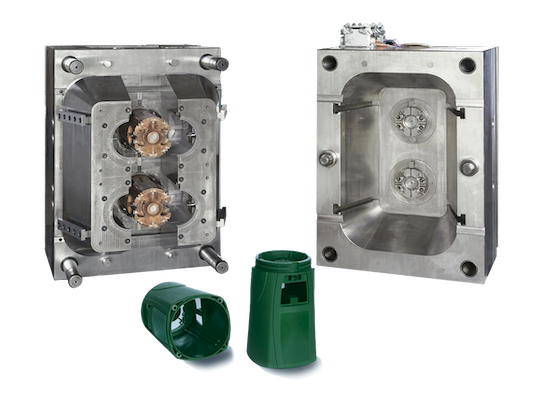
3. Gating System Optimization
Critical Considerations:
- Gate Placement: Align gate locations with mold flow analysis to prevent weld lines and air traps.
- Sprue & Runner Design:
- Confirm sprue bushings meet machine nozzle specifications (diameter, radius).
- Use submarine or cashew gates for hidden gates; ensure cold slug wells at runner ends.
- Gate Size & Finish:
- For decorative parts,., edge gates) to avoid post-processing.
- Maintain gate thickness at 0.35mm for side keys to prevent deformation.
4. Sliders and Lifters
Functional Validation:
- Slider Mechanisms:
- Ensure sliders use hardened wear plates (H13 for high-volume molds).
- Confirm distance = undercut depth + 2–3mm (safety margin).
- Avoid welding on cosmetic surfaces.
- Lifter Systems:
- Verify lifter travel ≥ undercut depth + 1.5mm.
- Check for interference with ejector pins during full ejection (minimum 2mm clearance).
5. Ejection & Cooling Systems
Performance Checks:
- Ejector Design:
- Place pins near high-shrinkage areas (e.g., bosses).
- Follow standardized anti-rotation designs for non-round pins.
- Ensure ≥1.5mm clearance between pins and mold walls.
- Cooling Channels:
- Maintain channel diameter ≥8mm (for mobile molds) and spacing at 3–5× the diameter.
- Label IN/OUT ports and prioritize uniform cooling to minimize warpage.
6. Exhaust & Final Validation
Critical Details:
- Venting:
- Add venting slots (0.02–0.04mm depth) near weld lines and thin sections.
- Use venting inserts for ribs deeper than 5mm.
- Post-Processing:
- Avoid welding on textured surfaces to prevent inconsistent etching.
- Standardize gate positions across multi-cavity molds.
Why Partner with JBRplas?
At JBRplas, we combine decades of expertise with rigorous protocols to deliver molds that exceed industry standards. Our proactive approach to design validation ensures:
- Reduced Downtime: Precision-tested sliders, lifters, and cooling systems.
- Cost Efficiency: Optimized material usage and extended mold lifespan.
- Scalability: Custom solutions for high-volume production or complex geometries.
Contact us today to discuss your project requirements and discover how JBRplas can elevate your injection molding process.