In injection molding production, many common defects—short shots, flash, inconsistent part dimensions, and unstable cycle performance—often stem from one overlooked root cause:inaccurate shot size calculation.
Most novice operators adjust injection pressure, speed, and hold pressure repeatedly to fix defective products, yet ignore the most fundamental process parameter: the exact material volume required for a single shot. Shot size is not just a numerical setting on the machine; it is the core benchmark that determines mold filling integrity, process stability, and production consistency. Mastering accurate shot size calculation is the first step to achieving high-yield, repeatable injection molding production.
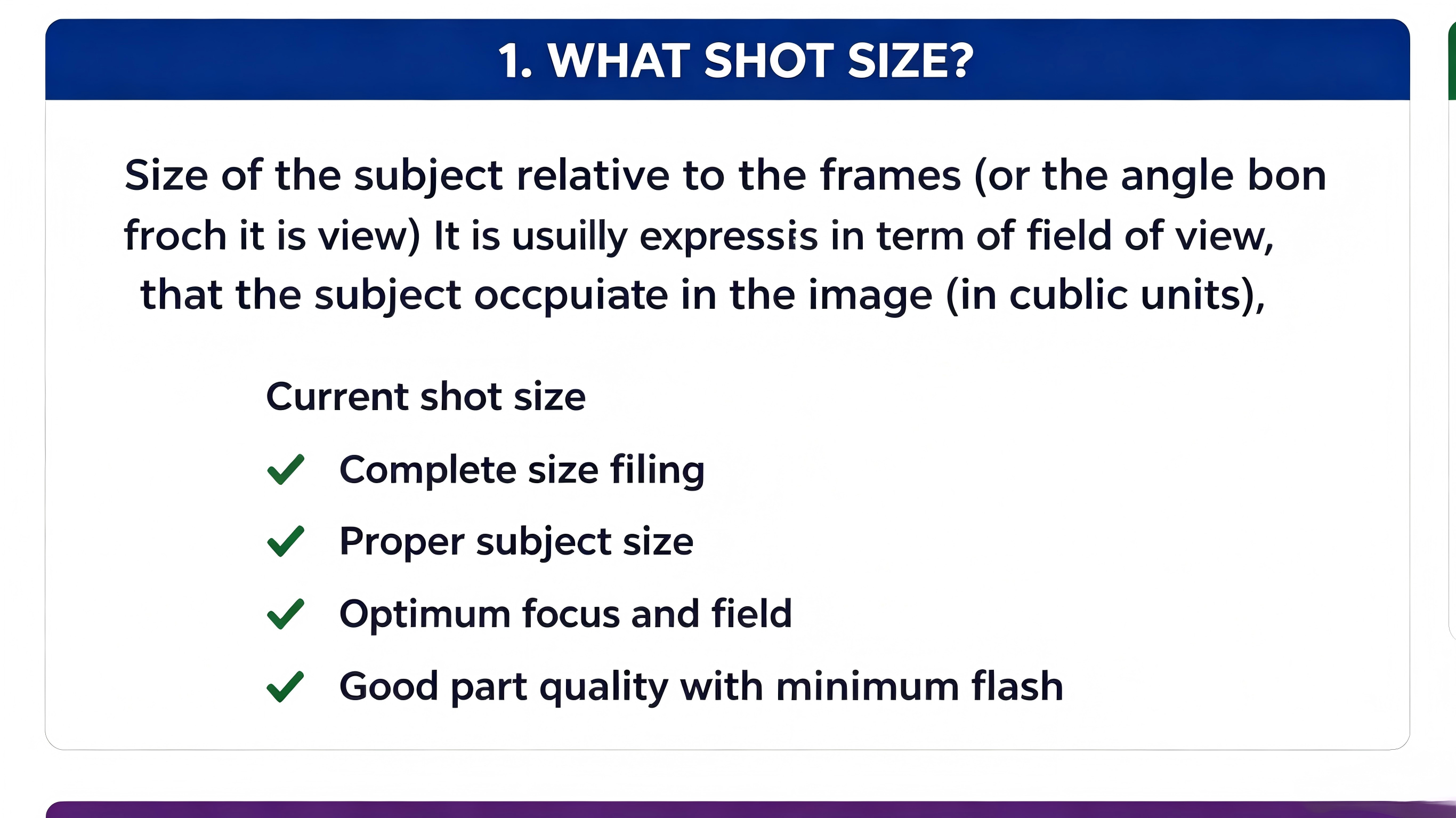
1. What Is Shot Size? Core Concept & Standard Formula
Shot size refers to the total volume or weight of molten plastic injected into the mold in one complete molding cycle. It covers all materials consumed to finish one product molding, including the finished part, runner system, and reserved cushion. Its universal core formula runs through all injection molding process settings:
Shot Size = Part Weight + Runner & Gate Weight + Cushion Volume
To match actual machine operation logic, we need to clarify a key matching principle: the machine’s rated shot capacity must always be greater than the calculated required shot size. A reasonable capacity margin ensures stable plasticization, complete mold filling, and effective cushion maintenance, avoiding process failure caused by insufficient machine output.
For multi-cavity molds, the calculation needs to be multiplied by the number of cavities on the basis of a single part, so as to avoid under-calculation leading to overall filling shortage. In actual industrial calculation, we can also convert volume and weight through material density, and fine-tune parameters combined with mechanical efficiency and material shrinkage rate to further improve accuracy.
2. Why Accurate Shot Size Calculation Is Indispensable for Production
Shot size is the foundational parameter of the entire injection molding process, and its accuracy directly determines product quality and production efficiency. Its core values are reflected in six key dimensions:
-
Complete Mold Filling: Accurate shot size ensures molten plastic fully fills every corner of the mold cavity, avoiding incomplete product structure and missing details.
-
Eliminate Common Defects: Effectively solves short shots, underfilling, and incomplete molding problems caused by insufficient material supply.
-
Stabilize Dimensional Accuracy: Avoids dimensional deviation of finished products caused by unstable filling volume, ensuring consistent product size in batches.
-
Maintain Stable Cushion: Reasonable shot size reserves a standard cushion for each cycle, ensuring stable injection pressure and hold pressure transmission, and reducing cycle fluctuation.
-
Reduce Material Waste: Prevents flash, burrs, and overpacking waste caused by excessive shot volume, lowering production costs.
-
Optimize Production Efficiency: Stabilizes the molding cycle, reduces defective rate and repeated debugging time, and improves overall production capacity.
3. Common Production Defects Caused by Incorrect Shot Size
Improper shot size setting (too large or too small) will trigger a series of process anomalies, which are also common pain points in actual production:
Shot Size Too Small
Insufficient molten plastic supply directly leads to short shots and underfilling. The product has incomplete edges and corners, thin-wall areas are missing, and multi-cavity molds are prone to uneven filling of individual cavities. Meanwhile, the cushion is too small or even disappears, resulting in uncontrollable injection pressure and unstable batch quality.
Shot Size Too Large
Excessive injection volume causes overpacking and flash. Excess material overflows the mold parting surface to form burrs, which increases post-processing workload. Excessive internal pressure of the mold will also lead to product deformation, shrinkage depression, and internal stress concentration, affecting product assembly performance and service life. In addition, redundant material melting increases cycle time and reduces production efficiency.
Long-term Inaccurate Calibration
Long-term deviation of shot size will lead to inconsistent molding conditions for each cycle, resulting in large fluctuations in product quality, increased machine operation load, and even abnormal wear of injection components, affecting the stability of long-term production.
4. Practical Tips for Shot Size Optimization
In modern precision injection molding, simple theoretical calculation is not enough. Combined with on-site process optimization, the shot size can be more adaptable to actual production conditions:
First, fully consider the material characteristics: different resins have different density, shrinkage rate and fluidity, which will affect the actual filling volume. For crystalline materials with large shrinkage, appropriate margin adjustment is required on the basis of theoretical calculation.
Second, reserve a reasonable machine margin: the actual required shot size is controlled at 70%–85% of the machine’s rated shot capacity, which can avoid unstable plasticization caused by full-load operation of the machine and leave adjustment space for subsequent process fine-tuning.
Finally, calibrate regularly with production batches: factors such as mold wear, material batch difference, and machine screw wear will cause subtle changes in filling volume. Regularly verifying and adjusting shot size parameters can maintain long-term process consistency.
5. Conclusion: Accurate Calculation = Stable Production
Injection molding process optimization is not a blind adjustment of pressure and speed, but a standardized and data-based optimization starting from the core parameter of shot size.
A precise shot size calculation can fundamentally avoid most filling defects, stabilize product dimensional consistency, reduce material waste and defective rate, and maximize the efficiency and yield of injection molding production. For every injection molding engineer and operator, mastering shot size calculation and optimization is the basic skill to achieve refined and intelligent molding production.
Have you encountered quality problems caused by unreasonable shot size in production? Welcome to share your debugging experience in the comment section!