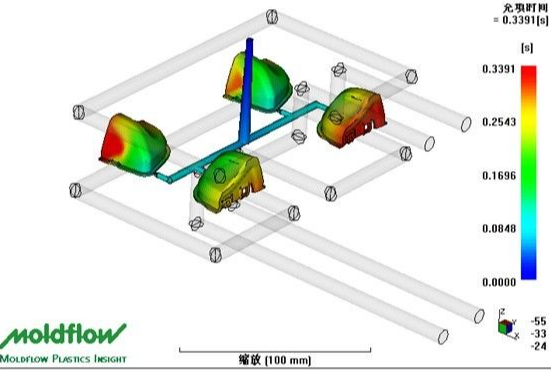
What is Mold Flow Analysis?
Mold Flow Analysis is a sophisticated Computer-Aided Engineering (CAE) simulation technique that predicts the behavior of molten plastic during injection molding. By analyzing 3D product geometry, material properties, and process parameters, engineers digitally simulate critical phases:
- Filling: Visualizing polymer flow paths and front advancement
- Packing: Optimizing pressure distribution for density uniformity
- Cooling: Modeling thermal gradients and heat transfer
- Warping: Anticipating residual stresses and dimensional instability
This virtual prototyping identifies potential failures before physical tooling begins, transforming uncertainty into engineering certainty.
Why Mold Flow Analysis is Non-Negotiable in Precision Mold Making
1. Optimized Gating & Flow Balance
MFA simulations scientifically determine optimal gate locations, sizes, and types (edge, submarine, or hot tip). This eliminates flow imbalances that cause:
- Short shots (incomplete filling)
- Sink marks and uneven packing
- Internal stresses leading to premature part failure
2. Defect Prevention at Digital Stage
MFA acts as a predictive diagnostic tool, identifying defects invisible during traditional design:
- Weld lines: Simulating polymer merging points to reposition gates or modify wall thickness
- Air traps: Pinpointing trapped air pockets for vent optimization
- Voids: Predicting shrinkage cavities in thick sections
Proactive correction at this stage reduces costly steel rework by up to 40%.
3. Cooling System Engineering
JBRplas leverages MFA to engineer conformal cooling channels that:
- Achieve uniform mold surface temperature (±2°C variance)
- Reduce cycle times by 15-30% through optimized thermal management
- Eliminate warpage caused by asymmetric cooling
By simulating pressure and thermal loads, MFA enables:
- Balanced filling that minimizes mold deflection
- Reduced shear stress on cores and inserts
- Predictable wear patterns for proactive maintenance
This extends mold lifespan by >25% while ensuring consistent part quality over 500k+ cycles.
5. Cost & Time Compression
Traditional trial-and-error sampling consumes 3-5 weeks and 15% of project budgets. MFA slashes this by:
- Reducing sampling iterations by 60-80%
- Accelerating time-to-market by 4+ weeks
- Eliminating late-stage design changes (costing 5-20x more than virtual fixes)
Conclusion: MFA as the New Standard
In precision-driven industries—from medical devices to automotive components—Mold Flow Analysis has become the bedrock of reliable mold manufacturing. JBRplas embeds MFA at the genesis of every project, transforming theoretical designs into manufacturable solutions. This commitment delivers quantifiable value: higher part quality, 30% faster development cycles, and 15-25% lower lifetime production costs. As material science and geometric complexity advance, MFA ceases to be optional.