WELCOME TO OUR BLOG

We're sharing knowledgein the areas which fascinate us the most
click

What Is Injection Molding? A Beginner's Guide to the Process, Materials and Tooling

By Sharon November 27th, 2026 2 views
Beginner's Guide · Injection Molding Basics · No Prior Tooling Background Needed

Injection molding melts plastic granules, forces them under high pressure into a shaped steel mold, and lets them cool into a solid part. Repeat the cycle a few thousand times and you get thousands of identical parts — that is the core idea behind most plastic products you use every day.

Reading time 7 min  /  Written for: product managers, new buyers, hardware founders and anyone new to plastic manufacturing

If you have never worked in manufacturing, injection molding can sound like a specialized engineering process. In practice it follows one simple idea: heat plastic until it flows, press it into a cavity shaped like your part, open the mold, and take the part out. The mold is what gives every copy the same shape; the machine is what keeps the process repeatable shot after shot.

This guide explains the basics without dense jargon. It covers what happens in each molding cycle, what a mold is actually made of, the resins you will hear about most often, and when molding makes sense compared with 3D printing or CNC machining.
The one idea to remember
One mold, thousands of identical parts
The tooling cost sits up front; once the mold is proven, each additional part is comparatively cheap and consistent.
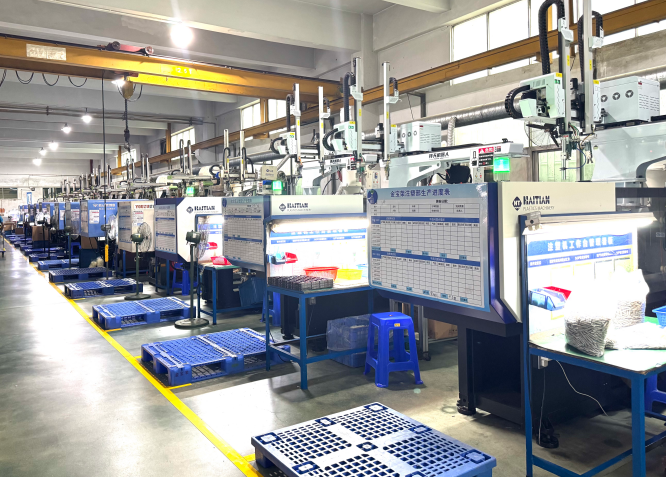
JBRplas – In-house Injection Molding Equipment

An injection molding machine: the hopper feeds plastic granules into the barrel, where they are heated and pushed through the nozzle into the clamped mold.

01What injection molding actually does

Think of it like a very precise, repeated cake tin. Instead of batter, you feed small plastic pellets; instead of an oven, a heated barrel softens the pellets into a molten fluid; instead of pouring by hand, a screw plunger pushes the melt at high pressure into a steel mold whose cavity is the exact reverse shape of your part. The plastic cools and solidifies inside, the mold opens, and the finished part is pushed out by ejector pins.

Because the shape comes from a hard steel mold rather than from cutting or printing, parts come out with consistent dimensions, smooth surfaces and repeatable quality across a long production run. That makes molding the default choice when you need more than a few copies of a plastic part.

02The six stages of one molding cycle

Every shot runs through the same short sequence. A typical cycle takes between a few seconds and around a minute, depending on part size, wall thickness and resin.

Stage What happens
1. Mold closed The two mold halves clamp shut under enough force to resist the injection pressure. Parting lines stay closed so no plastic leaks out.
2. Injection / filling The screw pushes molten plastic from the barrel through the runner and gate into the cavity, filling every corner and rib.
3. Pack & hold Pressure keeps feeding a little extra plastic as the material shrinks while it cools, preventing sink marks and hollow spots.
4. Cooling Water channels in the mold draw heat out until the part is solid enough to hold its shape. Cooling is usually the longest part of the cycle.
5. Mold open The machine separates the mold halves; the part stays on the moving side, held by the core.
6. Ejection Ejector pins push the finished part off the core. The mold closes again and the next cycle begins.
Cycle order repeats for every shot; small changes to temperature, pressure and cooling shape how the part fills and looks.

03What a mold is made of

The mold is the real tooling investment. It is a precision steel block machined to carry the reverse shape of your part. Once you know its main pieces, most mold drawings and supplier conversations become easier to follow.
  • Cavity and core. The two halves that form the outside and inside surfaces of the part.
  • Runner and gate. The channels that carry melt from the machine nozzle into the cavity; the gate is where plastic enters the part.
  • Ejector system. Pins or plates that push the finished part out after the mold opens.
  • Cooling channels. Water circuits inside the steel that control how fast the part solidifies.
  • Mold base and standard parts. Plates, leader pins, springs and fittings that hold the mold together and align it in the machine.
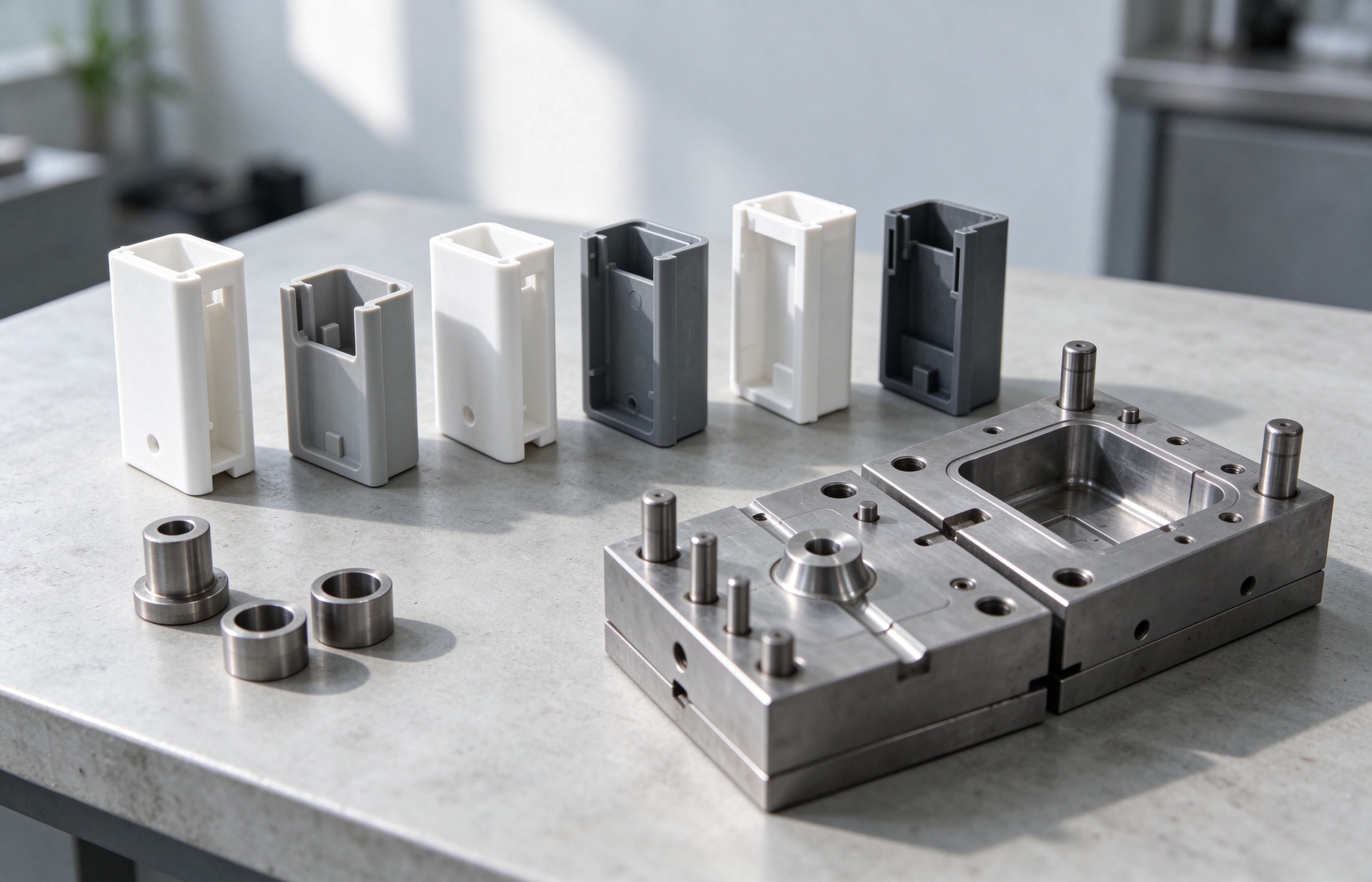
Finished molded parts beside an open two-half steel mold
Finished parts next to their mold halves. The cavity machined into the steel determines the part shape, so mold design and quality decide whether every copy matches.

04The resins you will hear about first

Material choice drives strength, appearance, cost and processing. These are the most common resins in everyday molded parts, in plain terms.

Resin Characteristics Common uses
ABS Rigid, easy to mold and paint, good surface finish; lower heat resistance. Enclosures, housings, consumer electronics covers.
PC Strong and impact-resistant, clear option; harder to flow and prone to stress cracking. Protective covers, transparent parts, structural housings.
PC/ABS Blend balancing PC toughness with ABS flow and finish; a popular enclosure material. Electronics and device housings, automotive interior parts.
PP Light, chemical-resistant and flexible; low cost, but harder to bond and print on. Containers, caps, hinges, consumer and household parts.
PA / nylon Strong and heat-resistant; often glass-filled for stiffness and wear resistance. Structural parts, brackets, power tool and automotive components.
TPU Flexible rubber-like material, used over a hard plastic in overmolding. Handles, grips, seals, soft-touch buttons.

05When molding is the right choice

Injection molding is rarely the cheapest way to make one part, but it becomes the most efficient way to make many. The deciding factors are volume, repeatability and part complexity.

  • 3D printing suits a few prototypes and quick design checks, but materials, strength and surface quality usually do not match production resin.
  • CNC machining suits small batches of precise parts cut from solid plastic, but it leaves waste and costs more per piece at higher volumes.
  • Injection molding suits once the design is settled and you need consistent, repeatable parts in the hundreds to hundreds of thousands.
Beginner rule of thumb Use 3D printing or CNC for early design validation, and move to a mold once the geometry is frozen and the forecast supports repeatable volume. Jumping straight to a steel mold before the design is settled is one of the most common new-product mistakes.

06The questions new buyers ask first

  • How many parts do I need? Volume decides whether prototype tooling, a bridge mold or a full production steel mold fits the project.
  • How long does a mold take? Simple aluminum prototype tools can be ready in weeks; production steel molds commonly take two to four months.
  • What does a mold cost? It depends on part size, cavity count, steel grade, runner type and surface finish — not on a single flat rate.
  • How tight a tolerance is realistic? Most molded parts hold practical tolerances; very tight dimensions need a deliberate mold and process plan, not just a note on the drawing.
Three mistakes beginners make
  • Ordering a steel mold too early. The design still changes, and every revision becomes an expensive steel modification.
  • Picking a resin by price alone. Heat, impact, chemical exposure and appearance all drive material choice, not just unit cost.
  • Reading a mold quote as one lump sum. Without a breakdown of steel, machining, runner and sampling, it is hard to compare offers fairly.
A mold is a one-time shape investment; every part after that copies the decision you made when the tool was designed.
Get the basics right up front, and production stays simple.

Have a new plastic part to tool?

Send your new project drawings — STEP or STL files, resin requirements and annual volume — to our mailbox. Our engineers will review DFM, mold feasibility and process risks, and reply with tooling recommendations and a quotation.

info@j-mold.com

DFM review and Moldflow flow analysis available before tool cutting
ISO 9001 / ISO 13485 · HASCO and DME standard bases · T1 trial report and dimensional inspection supported
JBRplas · Custom injection molds and precision molding · Shenzhen, China
Serving medical & dental, power tools, automotive electronics, POS and payment terminals, smart home, IoT and agricultural electronics, dispensing equipment, electrical relays and custom industrial hardware
JBRplas | Precision Injection Molded Plastic Parts for Smart Robotic Lawn Mowers,JBRplas
Previous
JBRplas | Precision Injection Molded Plastic Parts for Smart Robotic Lawn Mowers
Read More
Leave a message
First Name
Last Name
Email *
Message
Verification Code *
Click to verify
We use Cookie to improve your online experience. By continuing browsing this website, we assume you agree our use of Cookie.
Message Us