In industrial injection molding, the runner system acts as the critical melt delivery channel that connects the machine nozzle to mold cavities. As a core part of DFM tooling design, runner structure selection fundamentally changes project economics, production stability, and final part quality. Many product designers and manufacturing engineers prioritize cavity design but overlook runner system optimization, leading to excessive material waste, longer cycle times, unstable dimensional tolerance, and unexpectedly high mass production costs.
Cold runner and hot runner systems are the two mainstream solutions in modern plastic injection manufacturing. Each features unique structural logic, process adaptability and cost models. Cold runner molds focus on simplicity and flexibility for variable-batch production, while hot runner systems are engineered for high-efficiency, consistent high-volume output. To help manufacturers make data-driven tooling decisions, this article provides an in-depth comparison of the two runner types, covering structural principles, quantified production performance, practical pros and cons, and clear volume-based application scenarios.
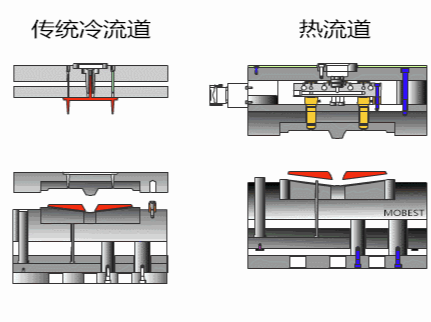
1. Fundamental Structural & Working Principle Differences
The essential gap between cold runner and hot runner molds lies in melt temperature control and runner material state during the molding cycle, which leads to entirely different production workflows.
A cold runner system is a traditional, unheated gating structure. The runner channels are carved on mold plates without any heating elements or temperature control modules. During injection, molten plastic flows through the runner to fill cavities. In the cooling stage, both the molded parts and the runner resin cool down and solidify simultaneously. Once the mold opens, the solid runner framework is ejected together with finished parts. Manufacturers must conduct secondary processes including runner separation, gate trimming and surface finishing to obtain qualified products.
A hot runner system, known as the “hot manifold system”, is a precision temperature-controlled auxiliary structure. Equipped with heating rods, thermocouples and independent temperature controllers, it maintains a constant high temperature inside the runner channels. This keeps the plastic resin in a molten state continuously during the entire production process. Only the plastic entering the mold cavity solidifies into finished parts, while the runner melt remains fluid for the next injection cycle. This mechanism completely eliminates solid runner scrap and streamlines the molding workflow.
2. Key Performance & Production Cost Data Comparison
Structural differences translate into measurable gaps in tooling investment, material utilization, production efficiency, quality stability and maintenance costs. The following industry-verified comparison table covers core evaluation dimensions for volume injection molding projects, supporting intuitive and accurate tooling selection:
|
Evaluation Metric
|
Cold Runner Mold
|
Hot Runner Mold
|
|
Initial Mold Tooling Cost
|
30%–60% lower; simple plate structure, no heating or temperature control components, low manufacturing threshold
|
30%–100% higher; additional costs for manifold, hot nozzles, heating system and precision temperature controller
|
|
Material Utilization Rate
|
60%–70%; 20%–40% of raw materials turn into runner waste per cycle
|
95%–98%; near-zero runner waste, almost all resin is used for finished plastic parts
|
|
Molding Cycle Time
|
Longer cycle; cooling time is restricted by thick runner solidification, becomes the main production bottleneck
|
12%–30% shorter; no runner cooling required, only cavity parts need cooling, greatly improving hourly output
|
|
Post-Processing Workload
|
Heavy; requires manual or automated runner cutting, gate polishing and burr removal
|
Minimal; parts are clean after ejection, no trimming needed for most scenarios
|
|
Part Quality Consistency
|
Average; prone to uneven filling, residual stress, weld lines and obvious gate marks
|
Excellent; balanced multi-point filling, stable melt temperature, reduced warpage and shrinkage deviation
|
|
Color & Material Switching
|
Fast and low-cost; solid runners are completely removed, no residual melt cross-contamination
|
Slow and wasteful; residual melt in manifolds requires large-volume purging for color/material changes
|
|
Daily Maintenance & Failure Risk
|
Low difficulty and low failure rate; only conventional mold cleaning and wear inspection needed
|
High requirement; needs regular temperature calibration, nozzle inspection and electrical component maintenance
|
3. In-Depth Pros & Cons Analysis
3.1 Cold Runner System: Flexible, Low-Risk Solution for Variable Production
The biggest advantage of cold runner molds lies in theirlow upfront investment and high production flexibility. With a simple and mature mechanical structure, the mold manufacturing cycle is shorter, and technical risks are significantly reduced compared with hot runner designs. For small-batch verification, prototype iteration and customized plastic parts, cold runner tools can quickly complete trial production and meet short-term project demands.
In terms of production adaptability, cold runner systems excel in multi-color, multi-resin alternating production. Since all runner materials solidify and are discharged after each shot, there is no residual melt retention, effectively avoiding material degradation and color mixing pollution. Meanwhile, the system requires no preheating or complex parameter debugging, enabling rapid machine setup and production startup.
However, cold runner’s inherent flaws limit its performance in mass production. First, severe material waste increases comprehensive production costs, especially for high-value engineering plastics such as PC, ABS and PA66. Although runner scraps can be recycled and re-granulated, recycled materials have reduced mechanical properties and stability, easily causing batch quality fluctuations. Second, the mandatory secondary trimming process increases labor costs and production takt time, restricting automated line operation. Third, unbalanced filling in cold runners often leads to inconsistent part shrinkage, resulting in higher dimensional defect rates.
3.2 Hot Runner System: High-Efficiency, High-Quality Solution for Mass Production
Hot runner technology is optimized to solve the core pain points of cold runner high-volume production. Its most prominent value is cost reduction and efficiency improvement in long-term continuous production. By eliminating runner waste, it saves a large amount of raw material consumption throughout the project lifecycle. The canceled runner cooling link greatly compresses the molding cycle, significantly improving single-machine hourly output and factory capacity.
In terms of quality control, hot runner systems maintain uniform melt temperature and pressure, realizing balanced cavity filling. This effectively reduces common defects including weld lines, sink marks, warpage and internal residual stress, greatly improving part dimensional accuracy and surface finish. For precision parts with strict tolerance requirements, hot runner design can significantly boost production yield and reduce post-quality rejection losses.
Nevertheless, hot runner systems have obvious application limitations. The high initial mold and equipment investment raises the threshold for small-batch projects. Complex structure and electrical components lead to higher failure risks; improper temperature setting will cause melt scorching, black spots or nozzle leakage. In addition, frequent color and material switching requires extensive purging, resulting in serious material waste and prolonged downtime, making it unsuitable for flexible iterative production.
4. Industrial Application Scenarios & Volume-Based Selection Rules
4.1 Recommended Scenarios for Cold Runner Molds
Cold runner systems are the most cost-effective choice for low-to-medium volume projects with annual output below 50,000 units. Typical applicable scenarios include product prototype verification, new product trial production, small-batch customized parts, and projects requiring frequent color or material replacement. In addition, for thermally sensitive resins that are prone to decomposition and yellowing under long-term high-temperature heating, cold runner is safer and more stable. For short-life-cycle products with quick iteration demands, cold runner’s low tooling risk and fast delivery can effectively avoid invalid high investment.
4.2 Recommended Scenarios for Hot Runner Molds
Hot runner systems show outstanding ROI in stable high-volume mass production with annual output exceeding 100,000 units. It is widely adopted in automotive plastic parts, home appliance structural shells, 3C electronic precision components, medical disposable parts and large-scale daily consumer goods. Industrial practical data proves that for long-term stable orders, hot runner molds can reduce comprehensive lifecycle production costs by 8%–22%. The saved material and labor costs, together with improved production efficiency and yield rate, can quickly offset the extra hot runner tooling premium.
5. Core Selection Principles for DFM Design
Runner system selection should never rely on subjective experience but comprehensive evaluation of production volume, product quality requirements, material characteristics, project cycle and total budget. For low-batch, flexible and iterative projects, cold runner prioritizes risk control and cost savings. For high-volume, long-term continuous production with high appearance and precision standards, hot runner is the optimal solution to maximize manufacturing benefits. For medium-volume transitional projects, semi-hot runner or insulated runner structures can be adopted to balance upfront cost and production efficiency.
Conclusion
Cold runner and hot runner systems have their irreplaceable positioning in volume injection molding. Cold runner molds focus on low cost, high flexibility and low risk, adapting to small-batch R&D and trial production. Hot runner systems focus on high efficiency, material savings and stable quality, becoming the standard configuration for large-scale mass manufacturing. Reasonable runner system design and selection is a key part of high-quality DFM optimization, which directly determines the final production cost, delivery efficiency and product competitiveness of injection molding projects.