WELCOME TO OUR BLOG

We're sharing knowledgein the areas which fascinate us the most
click

How much does an injection mold cost? Key cost drivers and quotation breakdown

By Sharon November 11th, 2026 11 views
Mold Engineering · Tooling Cost Guide · Procurement Reference

Mold prices are not random. Every figure on a tooling quotation traces back to six measurable inputs — part size, cavity count, steel grade, machining hours, runner type and surface specification. Once you can read those six, you can compare quotes instead of collecting them.

Reading time 9 min  /  Applies to: new tooling, tooling transfer, and cost-down reviews

Tooling is usually the single largest line item in a plastic part programme, and the one with the least transparency. Two suppliers can quote the same part at USD 8,000 and USD 32,000 with identical drawings in hand, and both can be technically correct — the difference sits in cavity count, steel grade, and how much of the mold was designed versus copied from a previous job.

This article breaks the number down. It gives indicative price bands for common categories, explains what each cost line actually covers, and ends with the checklist we use when reviewing a quotation for a customer — so that a low price and a cheap mold stop being confused with each other.
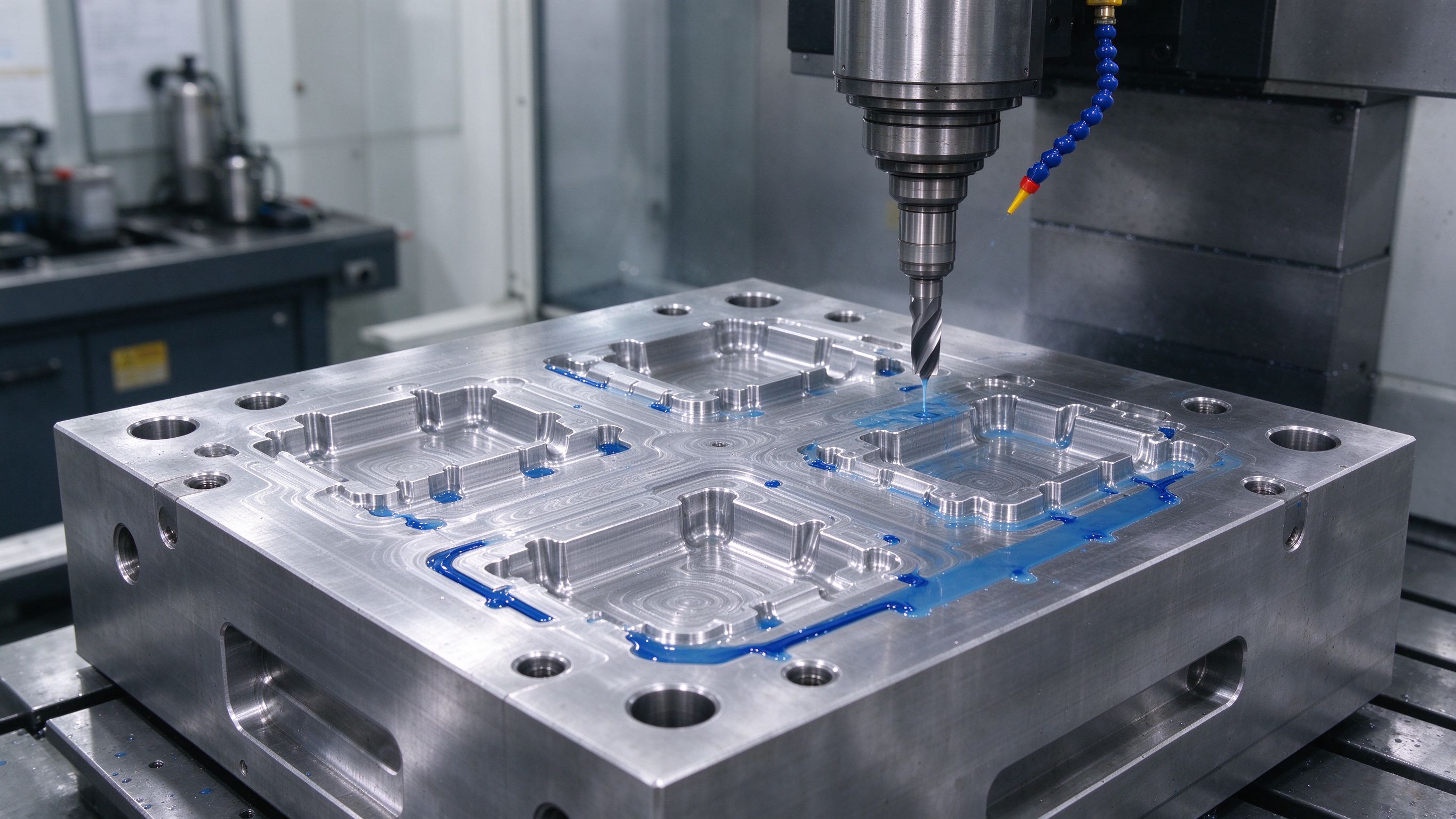
CNC machining of an injection mold cavity block
Roughing and finishing of a cavity block. Machining time on the cavity and core is normally the largest single cost line on a tooling quotation — and the first line a supplier trims when a price looks unusually low.

01What actually sits inside a mold price

A quotation that arrives as one lump sum tells you nothing. A quotation with six or seven lines tells you what you are buying. These are the cost blocks that make up the total, in the order they usually weigh on the final number.

Cost block Share of total What it covers, and how it swings
Machining hours 30 – 40 % CNC roughing and finishing of cavity, core and inserts, plus EDM for ribs, deep pockets and sharp internal corners. Doubling the part surface area roughly doubles this line.
Mold steel & inserts 12 – 22 % From pre-hardened P20 through 718H, H13, 1.2344 to stainless S136. Going from P20 to hardened H13 for a glass-filled resin typically adds 15–25 % to material cost and forces more machining hours.
Mold base & standard components 8 – 15 % HASCO, DME or Meusburger base plates, leader pins, ejector system, springs, water fittings. A standard base is cheap and fast; a custom base adds weeks and cost for no functional gain.
Runner system 5 – 20 % Cold runner is the baseline. A hot runner adds the manifold, controller, nozzles and wiring — a real cost jump, justified only when scrap, cycle time or gate cosmetics pay it back.
Surface finish & texture 3 – 12 % SPI polish grades, chemical texture (VDI or MT), laser etching, hard chrome. A high-gloss A-surface is hand-polished and is priced by hours, not by area alone.
Design, Moldflow & sampling 8 – 15 % DFM report, 3D mold design, flow simulation, steel correction after T1, trial shots and dimensional report. Suppliers that skip this line are not cheaper; they are deferring the cost to your T1.
Shares are typical for a mid-size engineering-resin part; small precision parts shift weight toward machining, large housings toward steel and base.

The cavity count effect

Cavity count is the single biggest lever on price, and the least understood. Going from 1 cavity to 2 roughly multiplies the cavity-and-core work by 2 but leaves base, runner and design largely fixed — so the tool might cost 1.6x while halving your per-part cycle cost. Going to 8 or 16 cavities changes the economics again: the tool becomes expensive, but unit cost drops far enough that volume above roughly 100,000 pieces per year almost always justifies it.

Rule of thumb Cavity count should be set by annual volume divided by the number of shots your press and cycle time can realistically deliver — not by how cheap the tool looks. A 1x8 tool for a 20,000-piece annual programme is money spent on capacity you will never run.

02Indicative price bands by mold category

The ranges below are for reference when sanity-checking a quotation. They assume a straightforward part without sliders, unscrewing cores or tight optical requirements, and they move with part size, tolerance and steel grade rather than with country of origin alone.

Category Typical part size Cavities Indicative tool cost (USD) Lead time
Prototype / aluminum up to 200 mm 1 3,000 – 9,000 2 – 4 weeks
Small precision part under 100 mm 2 – 8 12,000 – 40,000 5 – 8 weeks
Mid-size enclosure 150 – 400 mm 1 – 2 18,000 – 55,000 6 – 10 weeks
High-cavity production under 150 mm 8 – 32 45,000 – 120,000 10 – 14 weeks
Large housing, hot runner over 400 mm 1 – 2 55,000 – 150,000+ 10 – 16 weeks
Figures are indicative for engineering resins; they exclude freight, duty, gauge and any customer-supplied inserts.
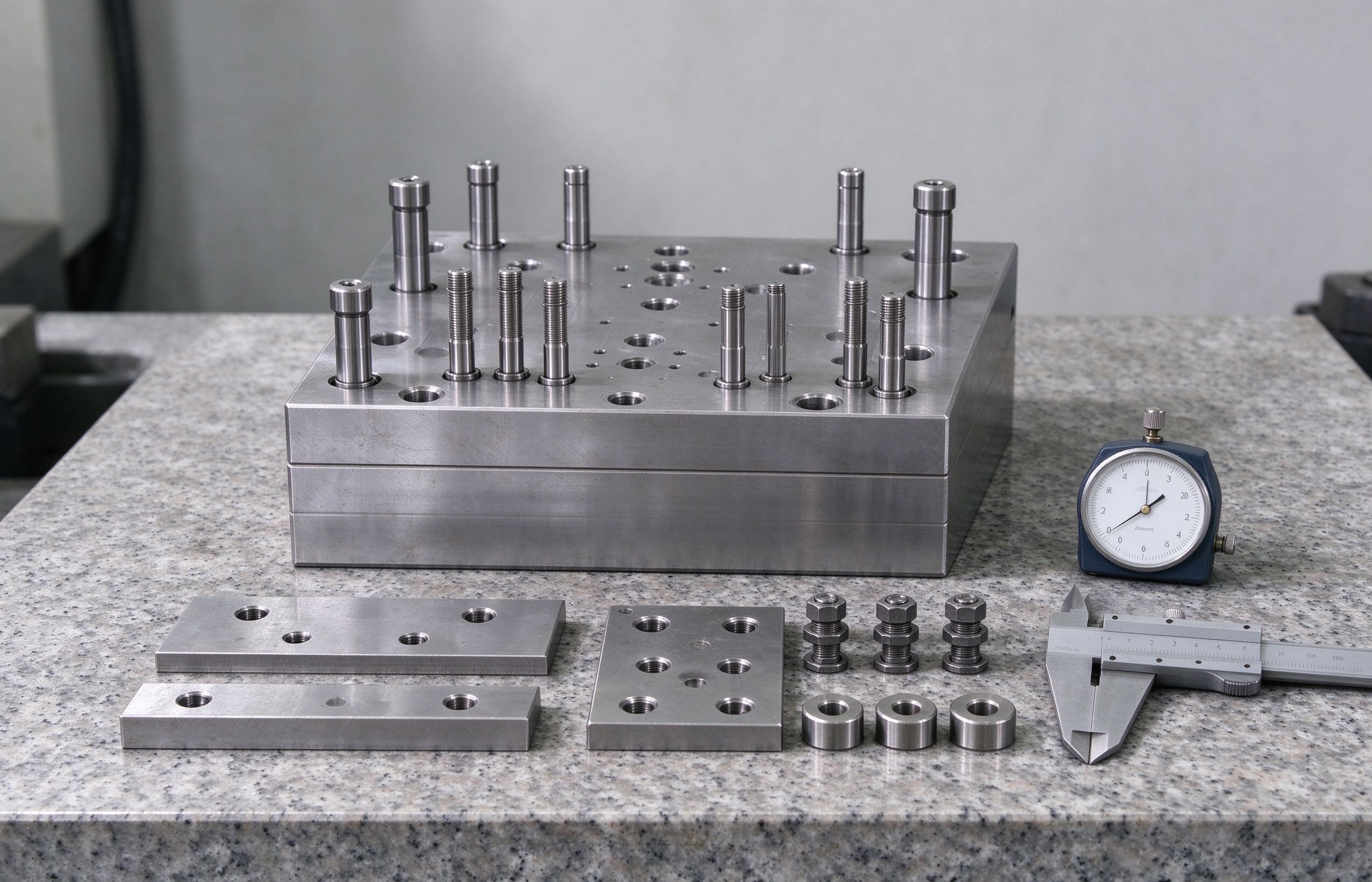
Mold base plates and standard components on an inspection table
A standard mold base with leader pins, ejector plates and fasteners. Figuring the base and standard components separately from the cavity work is what separates a readable quotation from a single opaque number.

03The five levers that actually reduce tool cost

Most cost-down conversations start with asking the supplier for a discount. That rarely moves much, because the number is already built from hours and material. What does move it is changing the inputs on your side before the design is frozen.

  1. Reduce cavity count to match real volume. Fit cavities to the forecast you can defend, not to the best-case scenario. Adding cavities later means a new tool; removing them saves money immediately.
  2. Specify the steel the resin needs, not more. P20 at HRC 30 handles most commodity resins for 100,000–500,000 shots. Reserve hardened H13 or stainless S136 for abrasive fillers, flame-retardant compounds, optical surfaces and medical parts.
  3. Use a standard mold base. HASCO or DME standard plates cut both cost and lead time, and make future spare-part sourcing trivial. A fully custom base should be a design decision, not a default.
  4. Simplify surface requirements where the customer will not look. A-surface polish on an internal bracket is money spent on nothing. Define A, B and C surfaces on the drawing and price the mold to that drawing.
  5. Do the DFM review before cutting steel. A one-hour review that removes a slider, relaxes a tolerance or shifts a gate regularly saves four figures in steel modification and two weeks of schedule.
A cheap mold is not a mold with a low price. It is a mold whose cost per good part, over its full life, is the lowest.

04Where the real cost hides in a low quotation

When a quote lands 40 % under the others for the same drawing, the difference is usually not efficiency. It is one of these:

Check these six lines before signing
  • Soft steel specified as production steel. The mold works at T1 and wears out at 30,000 shots, usually just after the warranty period ends.
  • Machining hours under-quoted. Deep ribs, thin walls and sharp internal corners get finished by hand, badly, and show up as inconsistent texture and flash.
  • Sampling rounds excluded. The quotation covers T1 only. Every correction after that is invoiced separately, and there are usually two or three.
  • Hot runner omitted or downgraded. A cheap manifold shows up later as gate freeze, colour change problems and scrap you pay for on every shot.
  • No Moldflow, no DFM report. The supplier is using your tool as the simulation, and you are paying for the outcome.
  • Mold ownership left vague. The contract does not state who owns the tool after payment, where it is stored, or how it transfers if you change molder.

05How to compare three quotations fairly

Comparing totals is the fastest way to buy the wrong mold. Normalise the offers first, then compare.

  • Confirm all three are quoting the same cavity count, steel grade and runner type — then confirm it again in writing.
  • Ask each supplier to split the price into the six cost blocks above, and to state the expected shot life in their specific steel and your specific resin.
  • Check what is included in sampling: how many trial rounds, dimensional report or not, steel correction after T1 included or billed.
  • Ask for the mold maintenance and spare-part terms, and the price of a future engineering change on the same tool.
  • Compare lead time on the same milestone basis — steel cutting, T1, approved samples — not on the supplier's own definition of delivery.

Three quotes normalised this way usually cluster within 15 % of each other. When one sits far outside the cluster, you now know which line it is, and you can ask the question instead of guessing.

Send us a drawing and get a broken-down quote

Share the STEP file, the resin grade and your annual volume. We return a quotation split by cost block, with the steel grade, cavity count and expected shot life stated explicitly — so you can compare it against your other offers line by line.

info@j-mold.com

ISO 9001 / ISO 13485 · HASCO and DME standard bases 
JBRplas · Custom injection molds and precision molding · Shenzhen, China
Serving a wide range of industries
POS terminal housing molding: cosmetic finish & anti-static requirements,JBRplas
Previous
POS terminal housing molding: cosmetic finish & anti-static requirements
Read More
Finding the RIGHT Mold & Injection Molding Factory near Baolilai Hotel,JBRplas
Next
Finding the RIGHT Mold & Injection Molding Factory near Baolilai Hotel
Read More
Leave a message
First Name
Last Name
Email *
Message
Verification Code *
Click to verify
We use Cookie to improve your online experience. By continuing browsing this website, we assume you agree our use of Cookie.
Message Us