If you've ever reviewed a mold drawing and noticed that the cavity dimensions are larger than the final product dimensions, you might have thought there was a mistake. In fact, this is completely intentional — and it's one of the most fundamental concepts in mold design. It's called shrinkage compensation (often referred to as "放缩水" in Chinese).
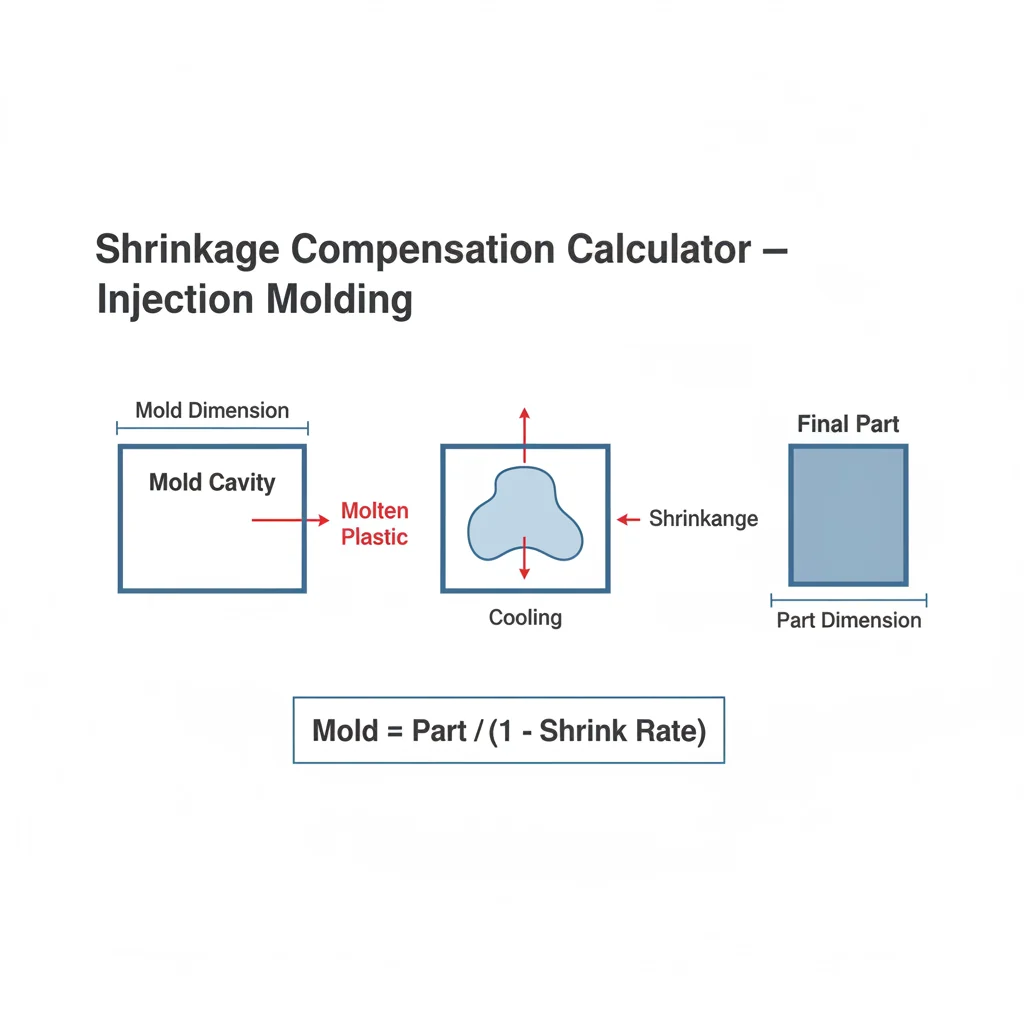
Thermoplastics expand when molten and contract as they cool and solidify. By the time a part comes out of the mold and reaches room temperature, it will be smaller than the cavity it was formed in. If the mold were cut to the exact nominal product dimensions, every part would come out undersized.
To compensate, mold dimensions are scaled up using a simple formula:
Mold dimension = Product dimension × (1 + Shrinkage rate)
Take a product with a nominal dimension of 100 mm, molded in PP (polypropylene) with a typical shrinkage rate of 1.5%:
Mold dimension = 100 mm × (1 + 0.015) = 101.5 mm
So the mold cavity is cut to 101.5 mm — and after cooling, the part shrinks back to approximately 100 mm, exactly as specified.
Shrinkage is not a single universal number. It depends on:
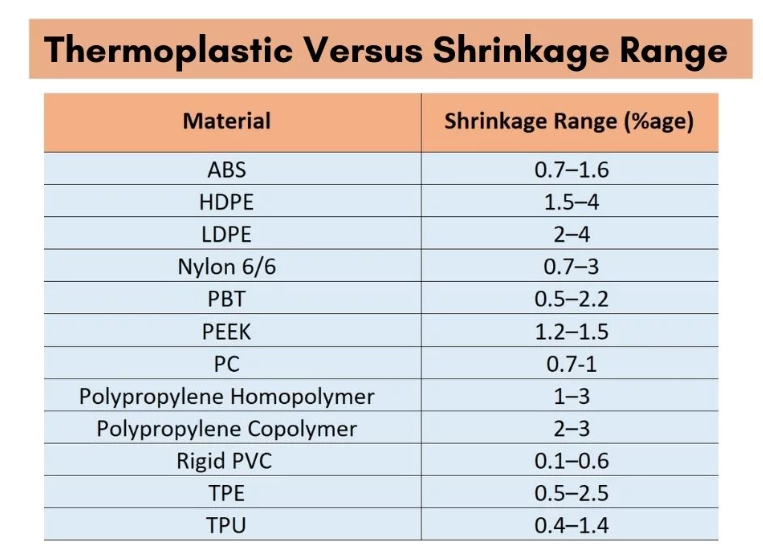
Material type — PP, ABS, PC, PA, POM and others each have their own typical shrinkage ranges (from as low as ~0.2% for some PC grades to 2%+ for certain crystalline resins like POM or PA).
Wall thickness — thicker sections cool more slowly and shrink more.
Fiber reinforcement — glass-filled grades shrink far less, and often anisotropically (differently in flow vs. cross-flow directions).
Processing conditions — mold temperature, injection pressure, holding time and cooling rate all influence the final result.
Part geometry — flow length, ribs, bosses and gates all affect local shrinkage.
This is why shrinkage values in material datasheets are given as ranges, and why experienced mold designers don't simply apply a single blanket factor to the whole part. Critical dimensions may be compensated individually, and some designs deliberately leave "steel-safe" allowance so the mold can be adjusted after T0 trials.
When you see mold dimensions larger than your product drawing, it's not an error — it's the mold being built so that the final part meets your drawing. A few practical takeaways:
Always share your material specification early. The shrinkage rate used in the mold design depends on the exact grade — a last-minute material change can invalidate the compensation.
Expect T0 samples to be measured, not assumed. Shrinkage predictions are estimates; actual dimensions are verified during trials, and fine adjustments (steel correction) are normal.
Don't compare mold drawings directly to product drawings. The mold is dimensioned in "mold space," not "part space." Ask your toolmaker for the compensation factor used if you want to verify.
Shrinkage compensation is standard practice, not a mistake. Plastic cools and contracts, so the mold must be made larger than the finished part — typically by 0.2% to 2%+ depending on material and geometry. The formula is simple: mold size = product size × (1 + shrinkage rate). Understanding this principle helps customers read mold drawings with confidence and ensures smoother communication from design through T0 and mass production.