Robotic lawn mowers are widely adopted across UK residential and commercial gardens. The British climate creates extreme, year-round challenges for outdoor plastic parts. Rain, frost, temperature fluctuations, UV radiation, stone impact and continuous collision all test the durability of robotic mower housings.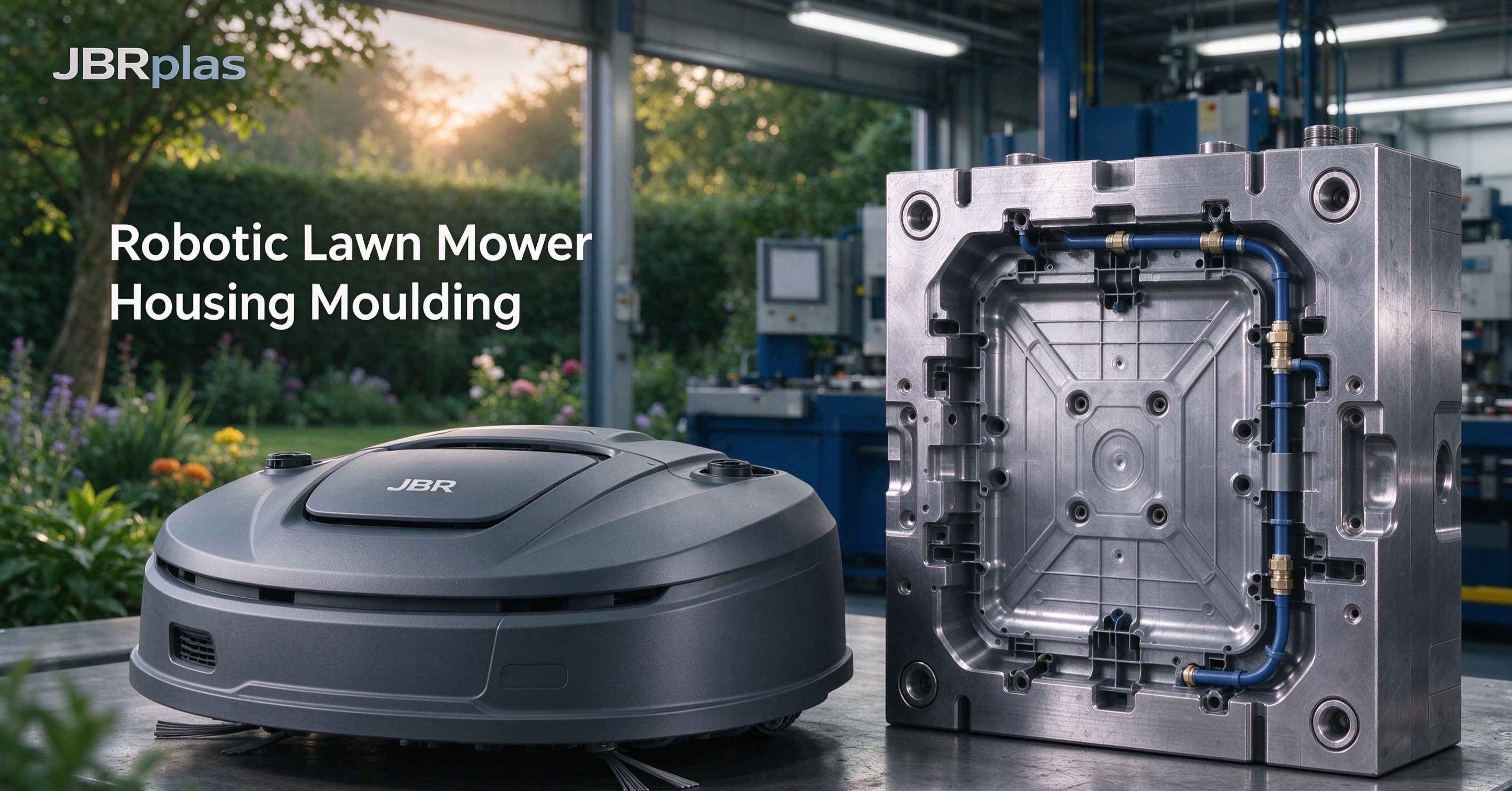
Many prototypes look perfect in the workshop but fail within 12–24 months after deployment in real UK gardens. Typical defects include:
These issues are not only cosmetic. They break waterproof sealing, expose internal electronics, raise warranty costs and damage your brand. Almost always, the root causes fall into two categories:
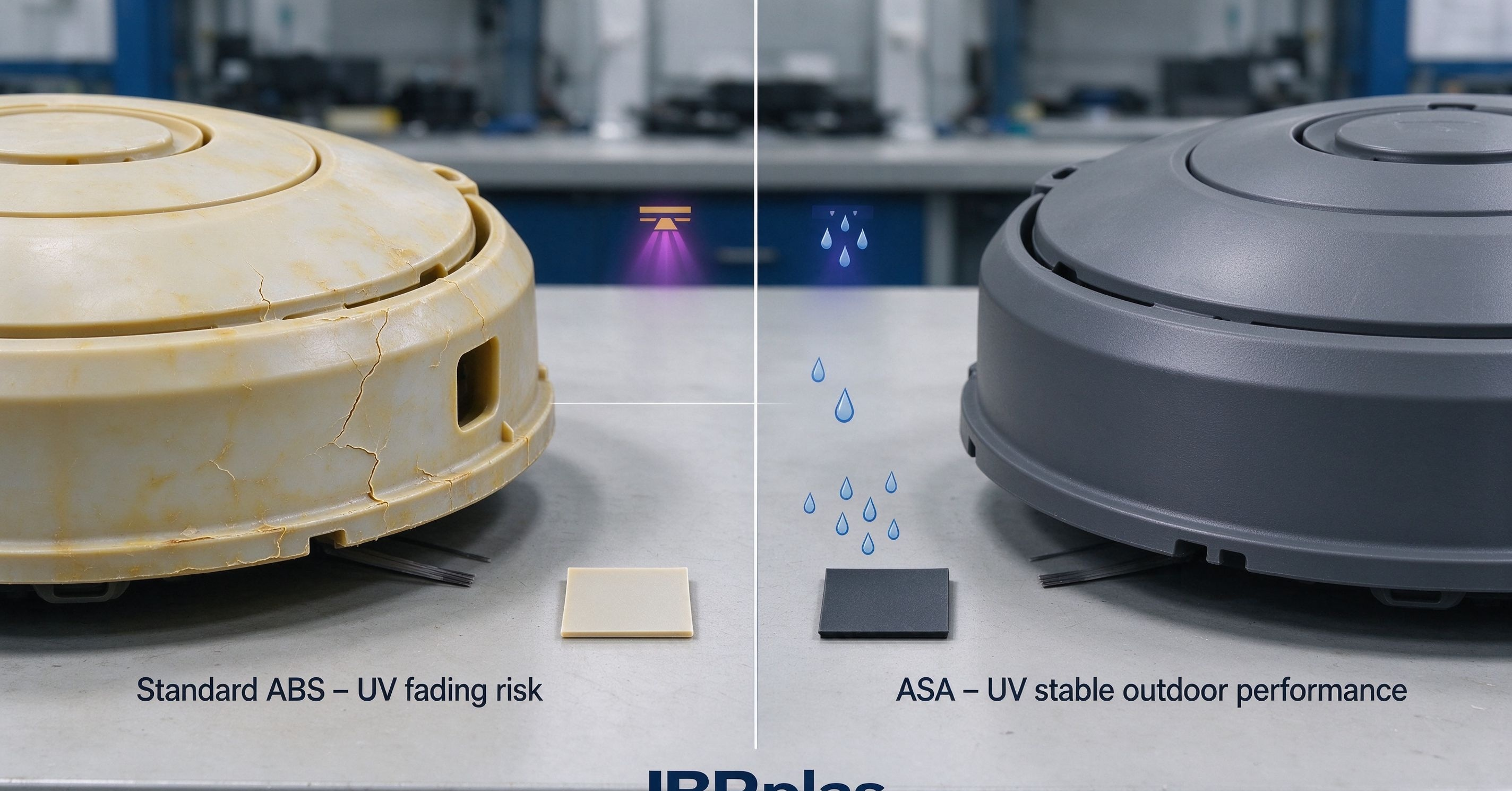
ABS is cheap and easy to mould for indoor products, but it performs poorly for permanent outdoor deployment in the UK:
UK robotic mower designers increasingly select these three outdoor-grade materials:
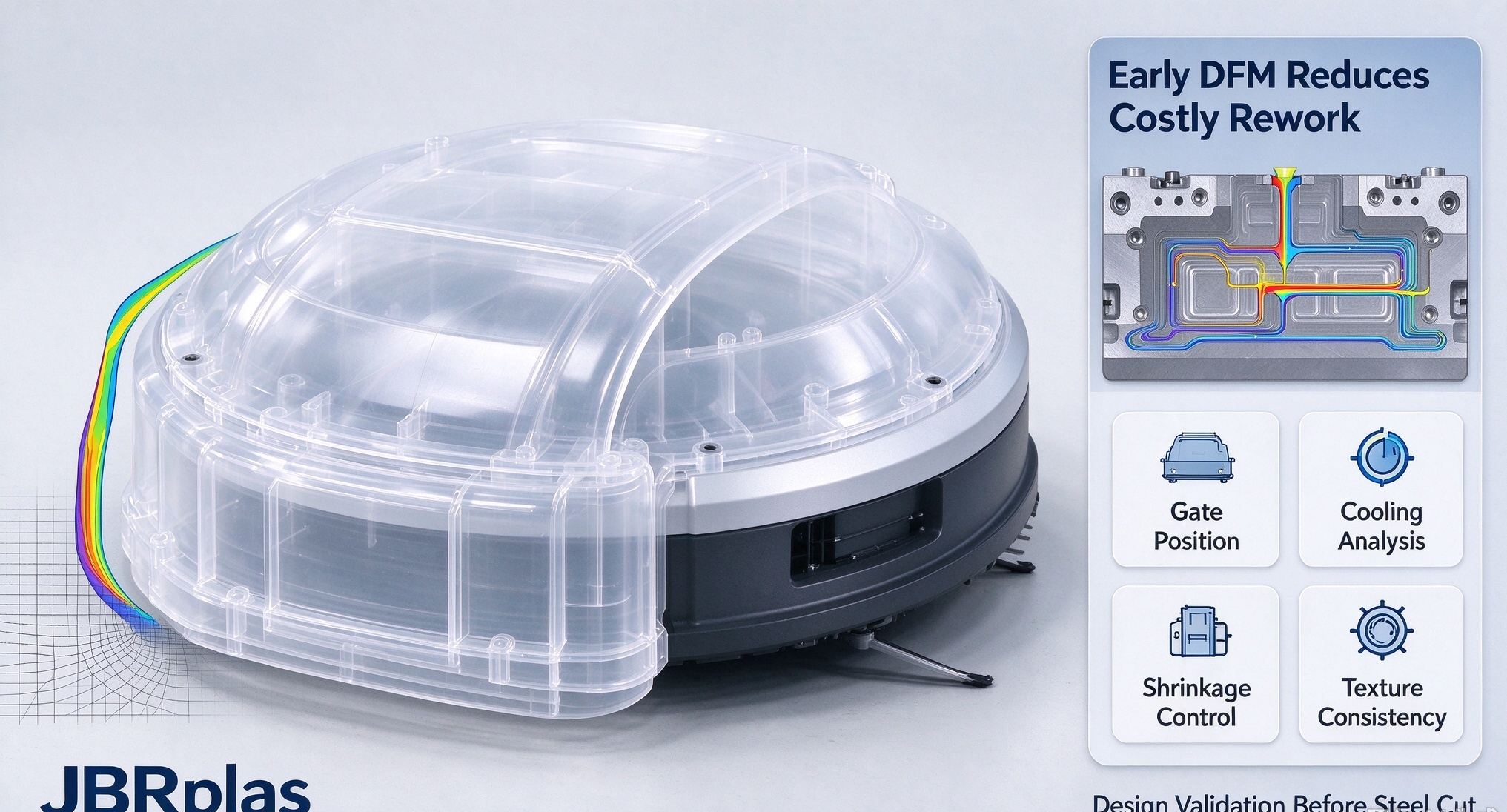
Premium polymer still fails if part geometry and mould design are not optimised. Large curved mower housings bring unique moulding risks:
They are sensitive to differential shrinkage, flow lines, sink marks and warpage. Minor design oversights on drawings can turn into expensive mass production problems.
At JBRplas, we advise bringing mould engineers onboard before design drawings are finalised.
Small optimisations can eliminate most defects before steel cutting:
Mould revisions at a later stage are slow, expensive and often ruin the surface finish of large cosmetic housings.
We focus on custom tooling and injection moulding for robotic lawn mower housings, sensor shrouds and charging docking enclosures.
Design consultation → Mould flow analysis & DFM feedback → Prototype sampling → Pre-production validation → High-volume serial production
We work as a complementary partner. Local moulders keep customer ownership and technical control, while we handle large moulds and high-volume runs when their capacity is tight.
UK garden equipment regulations on sustainability keep tightening.
We help engineering teams balance eco-targets without sacrificing UV and impact performance for year-round garden use.
If you are developing a new robotic lawn mower, upgrading an existing enclosure or sourcing a secondary moulding supplier, contact the JBRplas team.
Share your design brief, warranty targets and material requirements. We will provide material suggestions, DFM feedback, sampling schedules and clear quotations for your garden robot enclosure project.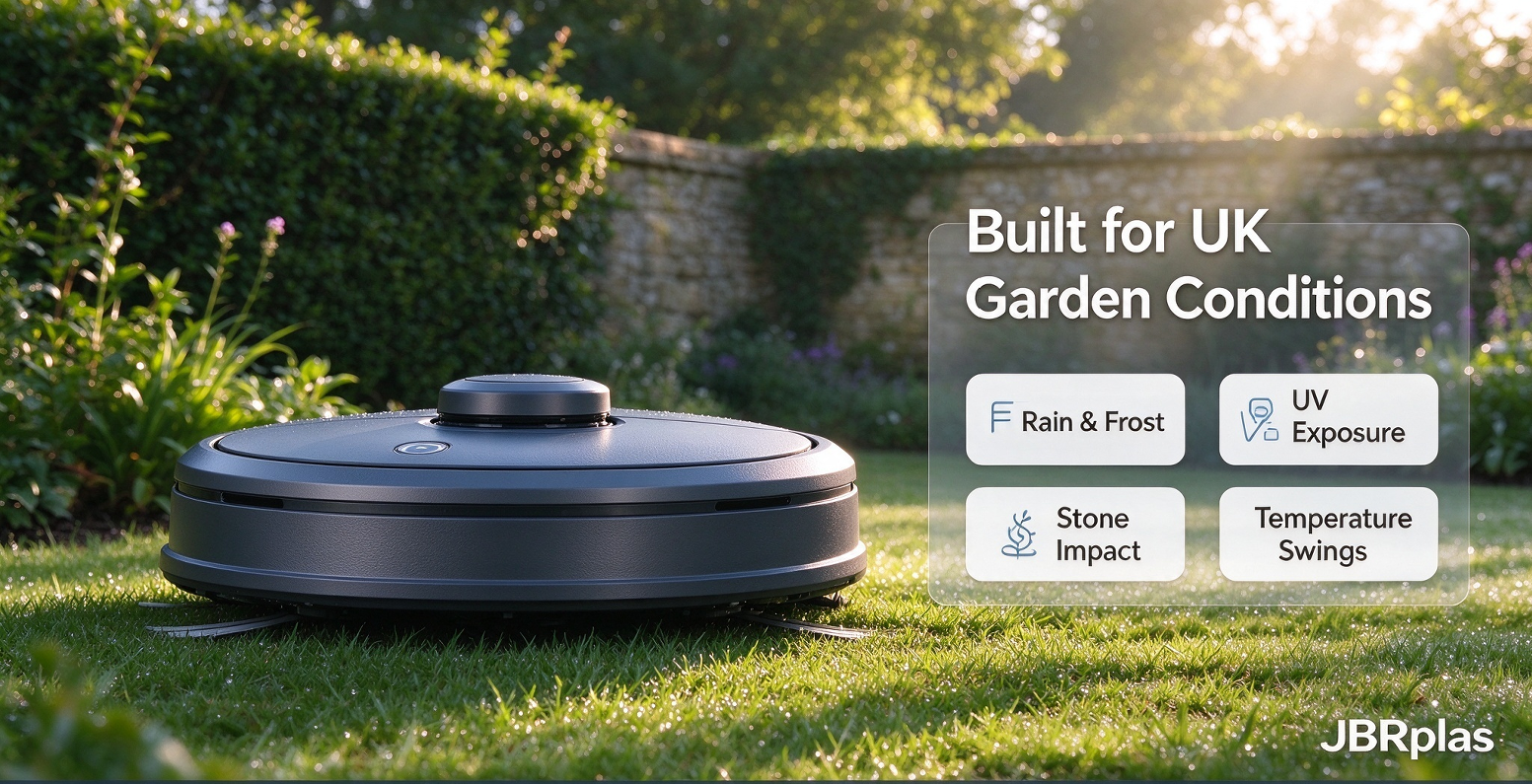
A: ASA is preferred for cosmetic outer shells. PC+ASA suits high-impact bumpers, and UV-stabilised PP works well for hidden structural parts and docking station shells.
A: Fading and chalking usually come from non-UV-stabilised plastics such as standard ABS, or low-quality recycled materials missing enough UV additives.
A: Yes. We act as an offshore production partner for UK moulders for large garden robot housing moulds and high-volume orders when their in-house capacity is limited.
A: We use PCR for suitable parts. For visible exterior shells, we fully validate the formulation to ensure it holds up to UV exposure and impact in UK outdoor environments.
A: DFM review, mould flow simulation, custom mould manufacturing, prototype sampling, pilot production, mass injection moulding and secondary finishing including laser marking and grain control.