A part can look flawless in CAD, yet fail miserably on the molding floor—often because its wall thickness logic is broken.
In injection molding design, uniform wall thickness isn’t just a “nice-to-have.” It directly impacts every critical stage of the process: how the melt flows, how the part packs, how it cools, how it shrinks, and how consistent its dimensions stay in production.
When walls get too thick, too thin, or change abruptly, defects follow fast:
- Sink marks and internal voids from uneven cooling
- Warpage caused by unbalanced shrinkage
- Short shots or hesitation as the melt struggles to fill uneven paths
- Visible weld lines and unstable dimensions
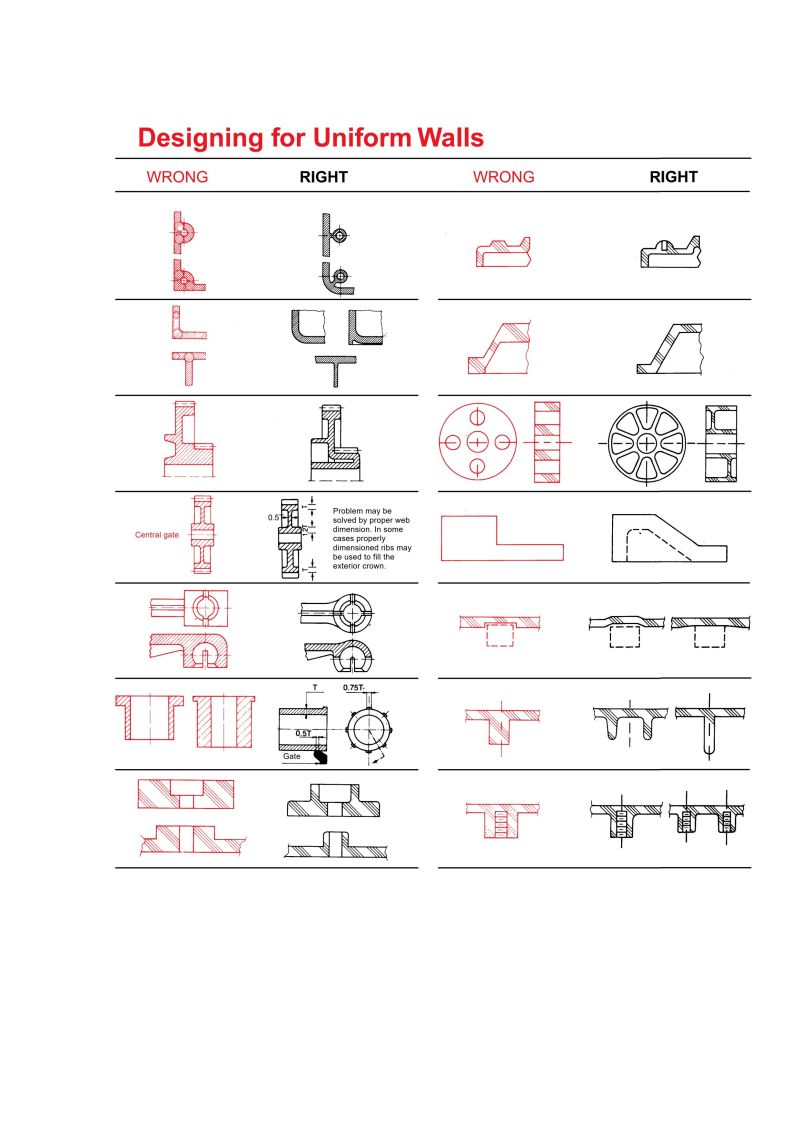
The Most Common Wall Thickness Mistakes (And Why They Kill Parts)
I see these issues derail projects every day:
- Thick bosses that leave sink marks on show surfaces
- Overly heavy ribs that “print through” the part’s exterior
- Abrupt wall transitions that create cooling imbalances and warpage
- Extra material added “for strength” that later causes severe shrinkage issues
The root cause? Treating bosses, ribs, and thick sections as only mechanical features—not molding features. Good molding design isn’t about adding more plastic. It’s about placing material where it matters for function, while keeping walls as uniform as the part allows.
A Simple, Actionable Approach to Get It Right
- Start with a clear nominal wall thickness that works for your material and process.
- Build stiffness with geometry (rib design, gussets) instead of unnecessary mass.
- Use gradual transitions (2:1 or 3:1 tapers) between thick and thin sections.
- Treat bosses and ribs as molding features first—size them to avoid sink marks (e.g., ribs ≤60% of nominal wall thickness).
- Think through fill, pack, cool, shrink, and eject before cutting any steel.
At the end of the day, the mold rarely exposes a “process problem.” It exposes a wall thickness problem that was already built into the part.
That’s why uniform wall thickness remains one of the most powerful DFM principles in injection molding.
💬 Question for you: Which wall-thickness mistake do you see most often in real projects—thick bosses, heavy ribs, or abrupt transitions?